Hey,
At this point, you already know that thinking about improving your life isn't the same as improving it.
Planning isn't the action. You can plan for months or even years and still end up in the same place. Meanwhile, one small, stupid action can benefit you more than all that planning combined.
You search for “the best way to do deep work,” open one video, then another, and suddenly three hours are gone.
That could have been the deep work session.
But searching for the perfect method feels easier. It feels clean. It feels like you're doing something useful, even when nothing is actually moving.
Two days ago, I met a friend who finished college more than a year ago. He wanted to start looking for jobs, so he began building his portfolio.
He showed me the first version around seven or eight months ago.
When I saw him again, I asked, “So, what's going on? Any jobs? Applications? Anything?”
He said, “No, I'm still working on the portfolio.”
Wtf.
It's been two decades. What are you building, Elon Musk's portfolio?
I asked him to show me the new version. It was almost the same portfolio he showed me months ago. A few things moved, some colors changed, but that was basically it.
In those eight months, he could have applied for jobs, built real projects, added experience to his CV, tried some freelance work, or just done something.
The portfolio didn't need to be special. It was already simple enough. Honestly, if I were in HR, I'm not sure the extra eight months would make me more likely to hire him.
Like Joey Diaz said: “You gotta do something.”
And this is the problem. Over-optimization has become a very convincing excuse for procrastination.
“I can't train back today because I need to rest my biceps, and my pre-workout finished, so I need to buy more first.”
“I'm not caffeinated enough this morning. I'll probably work later.”
“Let me finish planning the entire year, then I'll start the project.”
“I can't journal without my favorite pen.”
You need to hear this: you don't need any of that.
They're excuses, but they feel satisfying because they make procrastination look responsible.
You don't need a productivity system to start—even though I sell productivity systems. You don't need your favorite pen. You don't need ten plans, the perfect room, the perfect playlist, or the perfect Monday.
You need to lock in and do something.
Now, all those things can help. A good system, a clean room, a clear plan, and the right tools can make the work easier or feel satisfying at least.
But they become far more useful when you no longer depend on them to move.
That's what I call earning a productivity black belt. I'll go deeper into that in the next email.
A productivity black belt doesn't mean you have the perfect routine or never procrastinate. It means you know what matters, what doesn't, and how to keep moving the needle even when the setup isn't perfect.
That doesn't come from one productivity video. It comes from six to ten years of working, failing, procrastinating, finding motivation, losing it, becoming disciplined, becoming undisciplined again, and still returning until the process becomes part of you.
At that level, you might plan your entire next year in one sitting. But when something changes two weeks later, you can adjust without panicking or giving up.
If you miss a task today, your week isn't ruined. You move it, adjust the next task, and continue.
Your favorite pen, productivity system, or perfect plan can still make the process look and feel better. The difference is that you can handle yourself without them.
So if you're obsessed with optimizing everything—your room needs to be perfectly clean before you study, your plan needs to be flawless before you begin, and one missed task makes you rebuild the whole week—you're probably not optimized yet.
You're still depending on the setup.
The goal of optimization is to reach a point where you stop thinking about optimization so much.
Your YouTube and Instagram feeds stop being an endless stream of “10 productivity hacks.” They go back to being places where you sometimes watch something stupid and laugh for a few minutes.
You stop searching for the next perfect method because you already know what to do.
Now close this email and do one thing—even if it's small, badly planned, and not optimized at all.
See you in the next email: how to earn your productivity black belt
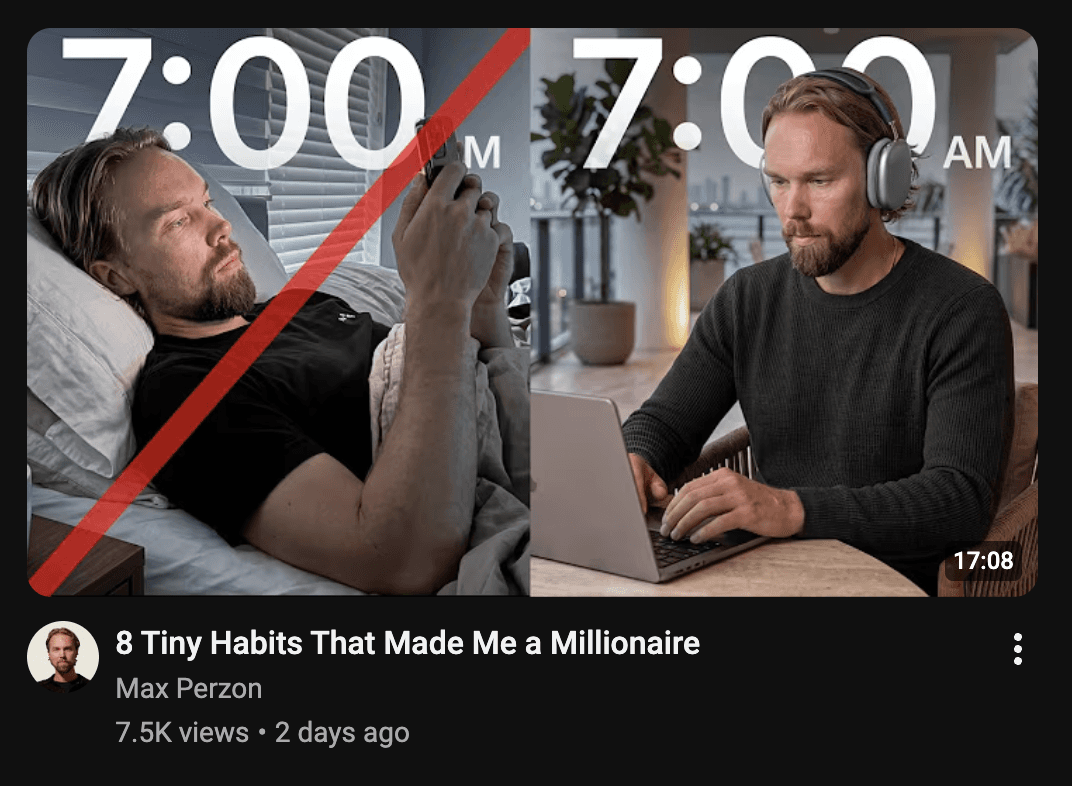
I've just opened YouTube,
Youtube:
How do people still post this crap?
Osama (OLS)